

Hotel refurbishment: how to transform walls with less building work and fewer rooms out of service
In a hotel, refurbishing a wall is rarely an aesthetic decision. It is an operational one.
Anyone running a property knows the materials budget is the easy part of the sum. The hard part is the rest: how many rooms go out of service, for how many days, at what point in the season, with how much noise and dust, and with what effect on what the guest writes afterwards on Booking. A wall covering can be excellent in a photograph and terrible on site — because it means emptying a whole wing for three weeks in the middle of the season.
This article is about that second sum. About judging a wall covering not only on price per square metre, but on what the installation does to the running of the hotel. And about where flexible stone — a mineral sheet material around 3 mm thick — can simplify that equation in certain situations, and where, honestly, it is not the right answer.
It is written for hotel owners, general managers, architects, interior designers and project managers working in Portugal. You do not need to know Korevo for it to be useful.
The real cost of refurbishing a hotel
Ask three contractors to quote for cladding the reception wall and you will get three numbers. None of them is the cost of the job.
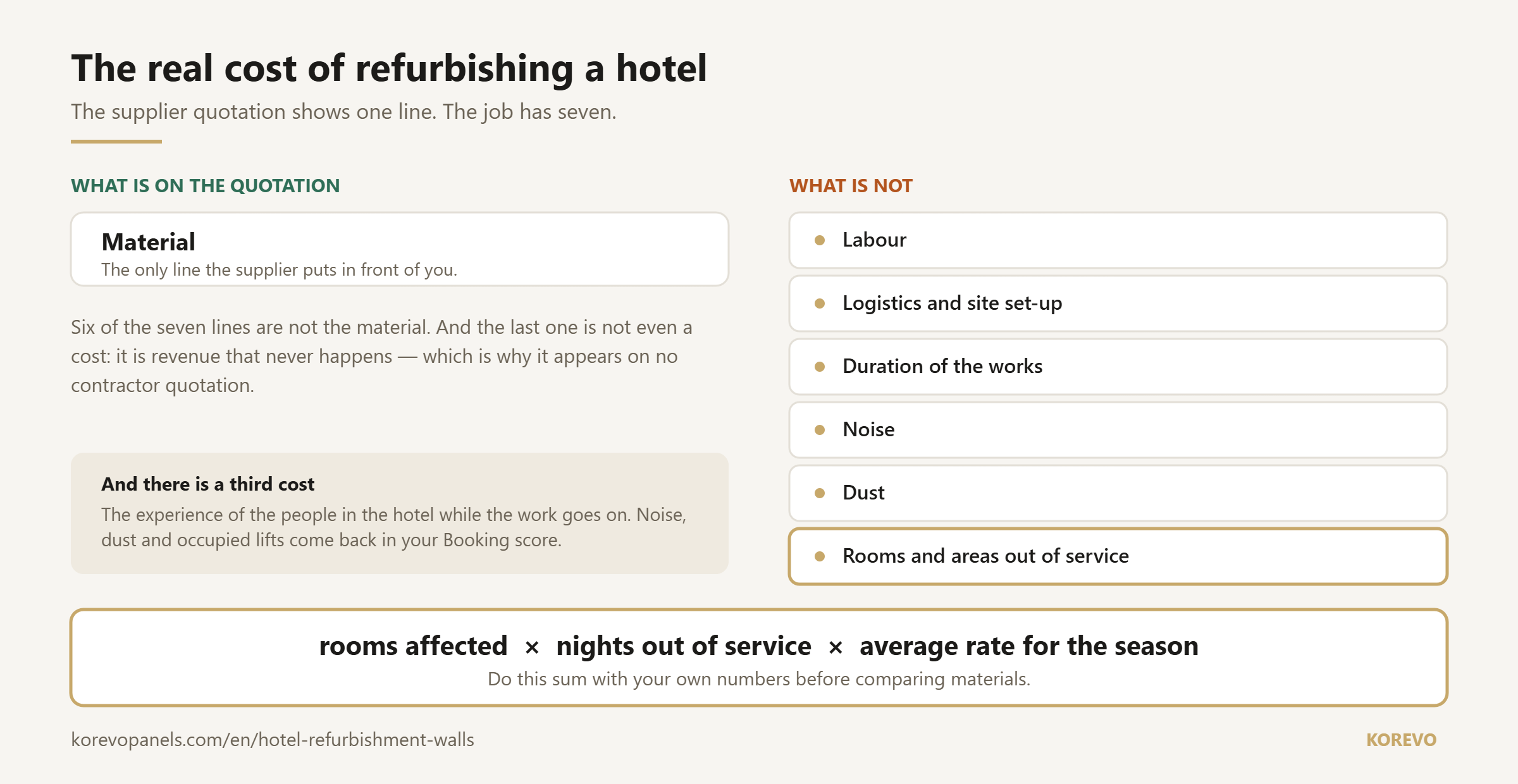
The real cost of hotel building works adds up at least seven lines — and the material is usually the smallest:
- Material — the only line that appears on the supplier’s quotation.
- Labour — normally several times the value of the material, especially where there is strip-out.
- Logistics — deliveries, storage on site, service lifts shared with housekeeping, waste removal, skips.
- Duration — every day on site is a day of coordination, of site safety, and of exception to the daily routine.
- Noise — the quiet enemy of your review score. A breaker at 9:30 is heard in twenty rooms, not one.
- Dust — it forces zones to be sealed off, systems to be protected, and deep cleans before reopening.
- Rooms out of service — bedrooms, function rooms or public areas that cannot be sold or used.
The line that never appears on a quotation
The line that almost always decides whether a hotel refurbishment is viable is the last one — and it is the only one that appears on no contractor’s quotation, because it is not a cost: it is revenue that never happens.
The formula is simple, and every hotel has its own numbers:
rooms affected × nights out of service × average rate for that season = revenue lost to the works
It is worth doing this sum before comparing materials, not after. A purely illustrative example, to show the order of magnitude: a wing of 8 rooms closed for 21 days is 168 room-nights. Multiply by your own shoulder-season rate and compare the result with the price difference between two wall coverings. In most cases the material difference is trivial next to the calendar difference.
That is why, in hospitality, the right question is not “what does it cost per square metre?” but “how many days does this take the space away from me?”
And the third cost: the guests who are still in the building
Refurbishing a closed hotel is a project. Refurbishing a working hotel is a military operation. The guest in room 214 does not know the work is in 216 — they know they woke at eight to a hammer drill, that the corridor smelled of adhesive, and that the lift was full of pallets.
That experience translates directly and measurably into reviews, into your score, and into the photograph the next guest sees before booking. In a sector where half a point on Booking moves occupancy, the installation method of a wall covering is a commercial criterion, not a technical detail.
The calendar, and why it is tighter in the Algarve than it looks
In the Algarve — and across much of Portugal — refurbishment happens between November and March. The window is short, the weather is unpredictable, and anything that needs drying, curing or wet trades competes with winter humidity. A system that depends on several layers with waiting times between them may simply not fit the window available.
Two things owners based abroad often discover late. First, that window is when every good applicator in the region is already booked, because every other hotel has the same window — book the trades before you finalise the material, not after. Second, a system that needs dry, warm conditions for adhesive or sealant is being asked to perform in the wettest months of the Portuguese year.
When you assess a wall covering for hospitality, the calendar is a technical specification like any other.
Why flexible stone can be interesting in hotel refurbishment
Flexible stone — also called soft stone or MCM — is a mineral-based wall covering, made from stone powder and clay with polymer binders, supplied in thin, flexible sheets. It is not a plastic with a photograph of stone printed on it, and it is not a thin-sawn slab of natural stone either.
The numbers that matter to whoever has to get it onto a hotel wall:
| Property | Value | Why it matters in a hotel |
|---|---|---|
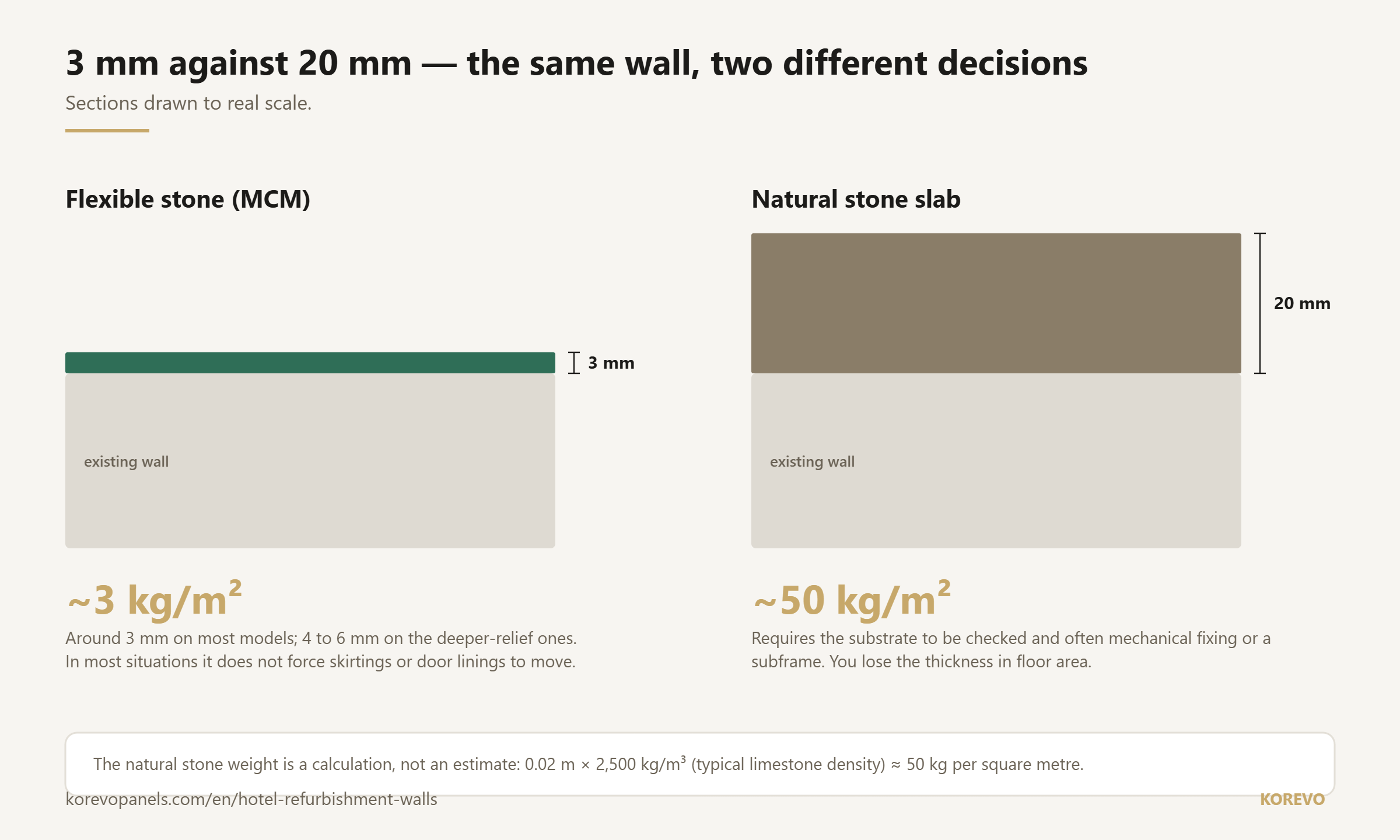
| Thickness | Around 3 mm on most models (4 to 6 mm on the deeper-relief models) | Takes practically no floor area and, in most situations, does not force skirtings, door linings or sockets to be moved |
| Weight | In the order of 3 kg/m² on the standard models | Avoids the structural check that a natural stone slab makes necessary |
| Sheet size | 120 × 60 cm sheets (0.72 m²); a kit of 8 covers 5.76 m² | Fits in a service lift and a goods hoist. No crane, no dedicated access |
| Cutting | Cuts with a utility knife or tin snips | No disc cutter, no wet cutting, none of the silica dust that comes with cutting stone or tile |
| Curved surfaces | Follows curves — the flexibility test on the exterior line refers to a 200 mm diameter | Round columns, arches and curved counter fronts without special pieces |
| Reaction to fire | The exterior line is classified Euroclass A2-s1,d0 in independent laboratory testing | A mineral material; it does not spread flame the way plastic coverings do. See the fire section below |
| Coastal exposure | 500-hour salt spray testing on the exterior line: minimal colour change, no cracking | Relevant for any property a few hundred metres from the Atlantic |
What this can change about site logistics
The operational advantage of flexible stone in a hotel is not in the material itself — it is in the type of building work it avoids in certain situations.
Where the existing substrate is sound, flat and well bonded, the sheets are applied over it. In many cases that means:
- No strip-out of the existing finish — so no rubble, no skip, and none of the days of breaking out that the whole floor can hear.
- Fewer wet trades — there is no new render drying for weeks before the finish can go on.
- Smaller, more frequent deliveries — material comes up in the service lift in kits, rather than on pallets that need dedicated access.
- Fewer trades at once — less coordination, fewer people circulating through guest areas.
All of this can reduce the complexity of the intervention and simplify site logistics, and can allow a less disruptive refurbishment in certain situations. What it does not do is turn a building job into magic.
What does not change — said plainly
There are claims that circulate in this market and that we do not make:
- Surface preparation still exists. A wall that is flaking, that has loose textured plaster, active damp or significant deviation has to be dealt with first. Flexible stone copies the defect in the substrate; it does not correct it.
- There is still adhesive, cutting and trimming. It is applicator’s work with its own rules — and the result shows above all in the joints, the corners and the trims against linings and ceilings.
- Installation time depends on the conditions of the project — substrate, preparation required, area, complexity of the trims, and the size and experience of the team. Anyone who gives you a programme before seeing the wall is guessing.
- It is not for everything. The section on hotel areas says exactly where we do not use it.
A note on transparency: Korevo supplies the material; we do not carry out the installation. We have no in-house fitting team and no labour rates. We work with refurbishment companies and applicators and, if you need it, we will look for references in the area of the project — but we will never tell you there is an available partner in your municipality before we have confirmed it.
Which areas of a hotel can benefit from this kind of wall covering?
Not every wall in a hotel is the same problem. Some are seen by every guest and by everyone who looks at the photographs before booking; some are seen by one person at a time; and some are exposed to grease, water or abrasion that no decorative covering enjoys.
This table is the honest reading, area by area.
| Area | Suitability | What to consider |
|---|---|---|
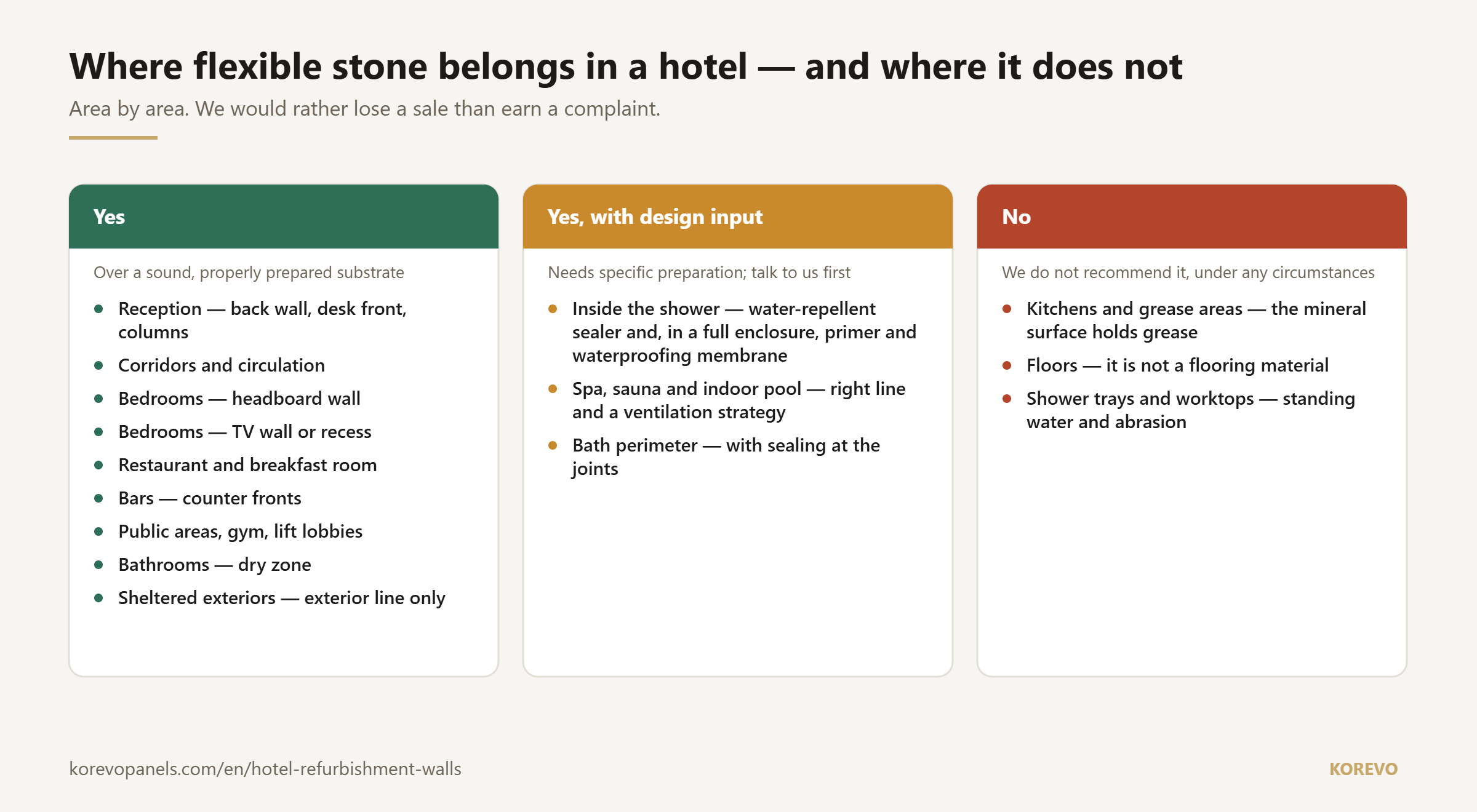
| Reception — back wall, desk front, columns | Very good | The most photographed surface in the hotel and the guest’s first impression. Small area, maximum impact. Curved desk fronts are solved without special pieces. |
| Corridors and circulation | Good, with care | They transform with little area and dry trades. Watch the lower zone: housekeeping trolleys and suitcases hit at the same height every day — allow for a rail, a taller skirting, or spare material for replacement. |
| Bedrooms — headboard wall | Very good | The focal point of the room and the photograph that sells the room type. Typically 3 to 9 m² per room, which makes a room refurbishment short per unit and easy to phase. |
| Bedrooms — TV wall or recess | Good | Adds depth without darkening the room. Check cable routes and TV fixings beforehand. |
| Restaurant and breakfast room | Good, with one exception | Walls and buffet fronts, yes. Open cooking areas, grills and fryers, no — see the note on grease below. |
| Bars and pool bar | Good | Counter fronts and back walls. Not on working tops or wet service surfaces: those are worktops, not walls. |
| Spa, sauna and indoor pool areas | Possible, needs design input | Permanently warm and humid. It only makes sense with the right line, specific preparation and a ventilation strategy. This is a case-by-case technical conversation, not a catalogue decision. |
| Public areas — lounges, gym, lift lobbies, circulation | Good | A good ratio between area treated and perceived renewal. Check reaction-to-fire requirements on escape routes. |
| Bathrooms — dry zone | Good | Walls outside the shower, the basin area, and the perimeter of a bath with appropriate sealing at the joints. |
| Bathrooms — inside the shower | Possible, with specific preparation | Requires a water-repellent sealer on the face of the stone and, in a full shower enclosure, a primer and waterproofing membrane before the adhesive. Good ventilation is decisive. Talk to us before deciding. |
| Sheltered exteriors — balconies, covered terraces, walls, gable ends, entrances | Good, with the exterior line only | Exterior line only. The salt spray and accelerated weathering tests exist precisely for this scenario. The condition of the substrate matters even more here. |
Where we do not use it — and why
We would rather lose a sale than earn a complaint. Three cases where the answer is no:
- Grease areas. Kitchens and cooking areas. The unsealed mineral surface holds grease very strongly and, once installed, cleaning becomes a permanent problem. This applies to production kitchens, pot-wash areas and grill stations — including outdoor ones.
- Floors. It is not a flooring material. In hospitality, with the traffic involved, not even in low-circulation areas.
- Shower trays, worktops and surfaces with standing water. Standing water and abrasion are two things this material was not made to take.
Want to know how much material your project needs?
The Korevo Project Planner works out the area and the quantity from your own wall dimensions, area by area. It works just as well for one reception wall as for a programme of 70 headboards.
A large visual change without necessarily heavy building work
There is a reason nearly every refurbished hotel of the last few years has, somewhere, a textured feature wall: it is the cheapest way to change how a whole space reads.
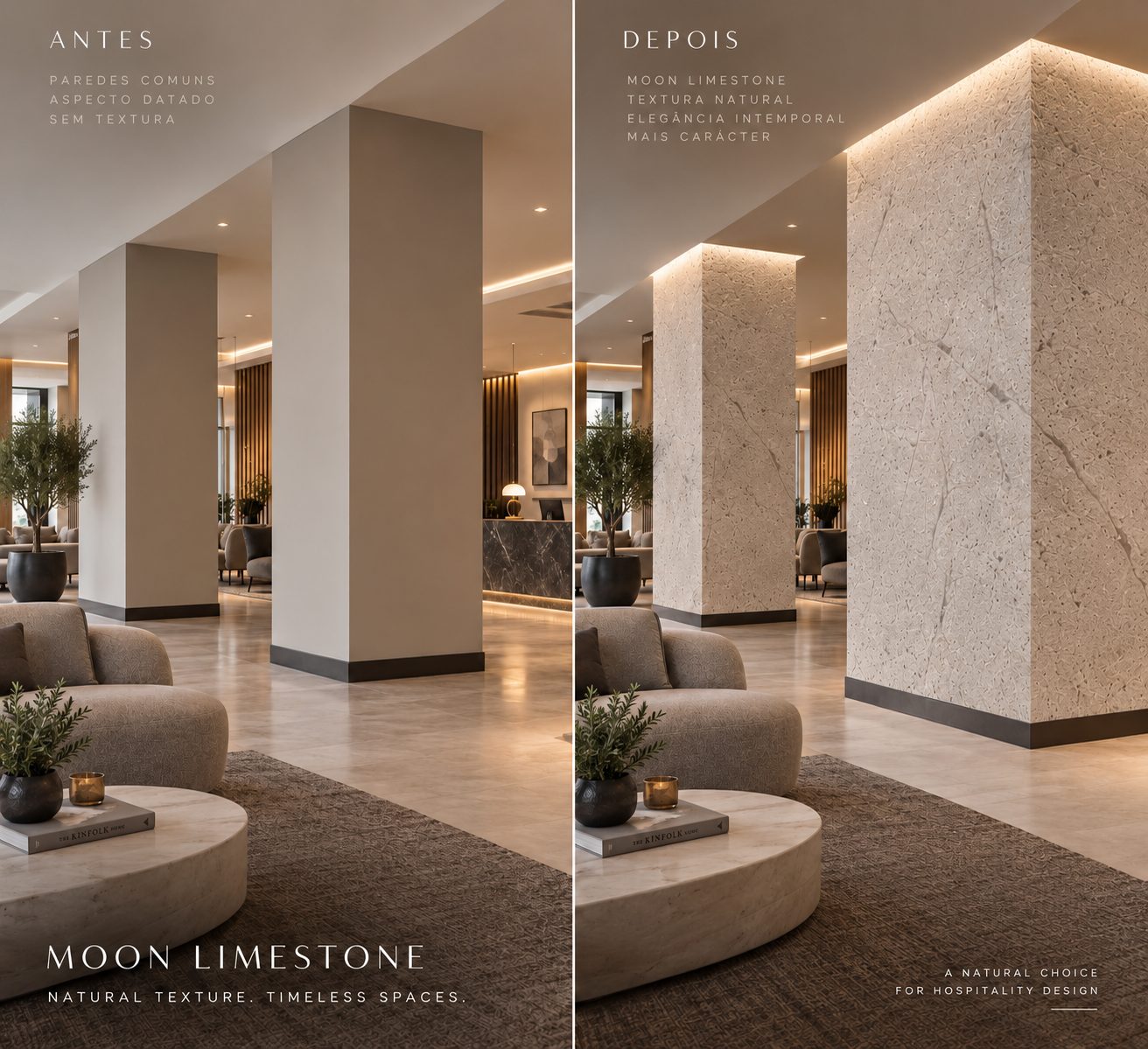
A flat painted wall returns light evenly and disappears. A wall with relief does the opposite: it creates micro-shadows that shift through the day, it gives depth to a space that on the plan always has the same dimensions, and it conveys mass — the sense that this is a solid building and not a painted plasterboard box.
Light does half the work
This is the point that separates a good scheme from a mediocre one, and it rarely appears in catalogues.
A textured covering only works if light crosses it at an angle. A downlight three metres out from the wall lights the wall and kills the texture — the relief flattens and the material starts to look like a print. The same material, with a track or a light line grazing the wall from 10–20 cm away, gains volume immediately.
In a hotel refurbishment that means one practical thing: the wall covering decision and the lighting decision are the same decision. If you are cladding the reception back wall, budget at the same time for the lighting change that will make it work. It is a small line in the budget that decides half the result.
The three surfaces guests photograph
If the budget forces you to choose, choose the surfaces that appear in the booking photographs — because those work for you even when there is nobody in the building:
- The reception back wall. It is in every piece of the hotel’s own photography and it is the first thing a guest sees on arrival. Typically 20 to 40 m².
- The breakfast room. The public space where guests spend the most waking time, and the one that appears most in guests’ own photographs.
- The headboard wall. The lead photograph for each room type on the booking channels. And the smallest area of the three.
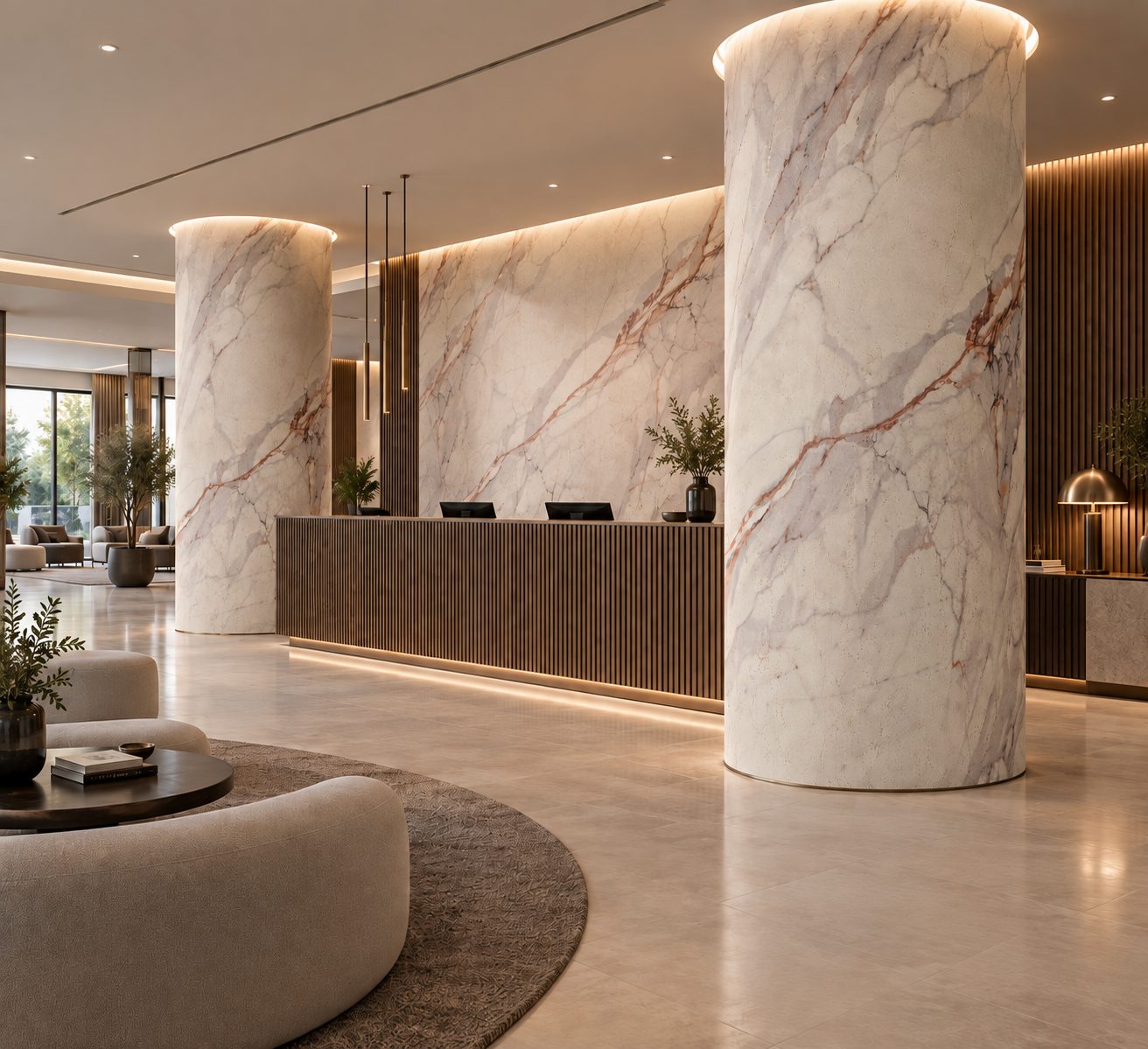
Modernising a dated space rarely requires changing its identity. In most properties we talk to, the hotel has already decided its aesthetic direction — it did so in the room types it has already refurbished. What is missing is extending that language to the vertical surfaces that have not yet been touched. It is a job of consistency, not reinvention, and it costs considerably less than it looks.
Joints are a design decision, not a defect
The question an architect always asks in front of a large panel is: where do the joints fall?
The sheet is 120 × 60 cm, so a wall panel is composed — as it is with large-format ceramic or natural stone slabs. The difference is what you do about it. With proper setting-out — planning in advance how the sheets land — the veining can be aligned from sheet to sheet, giving continuity of pattern across the whole panel, including around columns and corners. It is not a happy accident on site: it is design work done before the first sheet goes on the wall, and it is what decides whether the result reads as one piece or as a mosaic.
Two practical consequences for whoever is specifying:
- Ask for the setting-out drawing before you approve. On a reception panel or a column, the joint pattern and the vein alignment should be settled on paper.
- The pattern you choose changes the difficulty. Fine, non-directional mineral textures forgive almost anything; strongly veined, directional patterns demand more rigorous setting-out — and that is where the difference between an experienced applicator and an improvised one shows.
A note on range and consistency
Flexible stone comes in different visual families — pale limestones, travertines, slates, stacked-stone panels with deep relief, linen tones. In a hotel the temptation is to pick the most dramatic model for reception and something else for the bedrooms. The opposite works better: one tonal family across the whole property, with variations of intensity by area. Pale tones in circulation and bedrooms, where the aim is to open up and lighten; darker tones with deeper relief at focal points, where the aim is to concentrate the eye.
Natural stone and flexible stone: the honest comparison
Flexible stone does not replace natural stone. They are materials with different purposes, and there are projects where recommending flexible stone would be a technical and aesthetic mistake.
| Natural stone (slab or thick sheet) | Flexible stone (MCM) | |
|---|---|---|
| Typical thickness | 20 mm or more as a wall covering | Around 3 mm (4 to 6 mm on the deeper-relief models) |
| Approximate weight | A 20 mm limestone, at a density in the order of 2,500 kg/m³, weighs around 50 kg per square metre | In the order of 3 kg/m² on the standard models |
| Structural implication | Requires the substrate to be checked and often mechanical fixing or a subframe | In most cases raises no structural question on internal walls |
| Impact on floor area | You lose the thickness; skirtings, linings and frames frequently have to move | Practically none in most situations |
| Cutting and adaptation | Disc cutter, wet cutting, silica dust, noise | Utility knife or tin snips, dry |
| Curved surfaces | Needs special pieces or is not viable | Follows generous curves without special pieces |
| Authenticity at close range | It is stone. Read close up, by touch and in grazing light, it is irreplaceable | Very convincing at normal viewing distance; a trained eye sees the difference at 30 cm |
| Floors and wet areas | Suitable | Not suitable |
| Local repair | Replacing a slab is a small building job | Replacing a sheet is a localised job, provided material from the same batch is held in reserve |
| Where it wins | Schemes where the authenticity of the material is the argument; floors; wet areas; new build with no calendar constraint; asset value | Refurbishment over existing surfaces; buildings in operation; curved surfaces; large areas with weight, access or time constraints |
When to choose natural stone
- When the material is the argument — a lobby whose positioning depends on “this is stone” being part of the story.
- When it is a floor, a worktop, a shower tray or any wearing surface.
- When it is new build, the structure is prepared, and there is no working hotel above the programme.
- When exposure is severe and permanent — immersion, frost, continuous abrasion.
When flexible stone makes more sense
- When the wall already exists, is sound, and the aim is to change how it reads without demolishing it.
- When the building is in operation and the calendar matters more than the budget.
- When access is difficult — upper floors, small service lifts, no space for a site compound.
- When there are curves, round columns, arches or counter fronts.
- When the same detail has to be repeated across dozens of units with predictable time and cost.
See it and touch it before you decide.
No photograph settles this comparison. You can order Korevo samples and see the finishes in the light of the actual space, at the hour your guests are in it. For hotel projects we send samples of the tones under consideration for assessment on site.
What to check before choosing flexible stone
This is the section we would rather you read before asking us for a quotation. These are the questions we always ask — and the answers change the recommendation.
1. What is the existing substrate, and what condition is it in?
Flexible stone is a thin finish. It does not correct the substrate: it follows it. If the wall has visible deviation, it will read in the finished result.
- Sound, absorbent render, plaster or concrete — the simple case: flexible C2 cement-based adhesive.
- Tile or glazed surfaces — a frequent scenario in hotel bathrooms and kitchens. You do not bond onto a glaze without preparation: it needs abrading and a bonding primer, or a polymer adhesive for non-absorbent substrates.
- Plasterboard — works well, and is a common alternative to sanding and repainting. Check the board fixings and the condition of the joints.
- Textured plaster or paint with poor adhesion — this is the case to take seriously. If the paint or plaster lifts with a scraper, the problem is not the new adhesive: it is the layer underneath. It has to come off or be consolidated.
- Timber and joinery — contact or construction adhesive, not cement-based adhesive.
2. Is there damp? What kind?
Our position here is firm, and worth saying out loud: no decorative wall covering cures structural damp.
Condensation on a cold wall and localised rain penetration are problems that can be solved by works that include a new covering. Rising damp from the ground and active leaks are not: covering over hides the symptom for a few months and gives the problem back to you worse. Where there are signs of damp, the diagnosis comes first and the finish comes after. If anyone tells you otherwise, be sceptical.
3. What are the fire requirements of the project? (Portugal-specific)
This is the section owners based abroad most often reach too late, so it is worth setting out.
In Portugal, hotels fall under utilização-tipo VII — occupancy type VII, hospitality and catering — in the national fire safety regime for buildings (Segurança Contra Incêndio em Edifícios, SCIE). The technical regulation is Portaria n.º 1532/2008, amended by Portaria n.º 135/2020. It sets minimum reaction-to-fire classes for wall and ceiling coverings, and those requirements vary by location: an escape route does not carry the same requirement as a bedroom wall, and the building’s risk category also counts.
There is one more thing a foreign owner should know: in Portugal the person who signs this off is the project’s SCIE designer (projetista de SCIE), a qualified professional registered for the purpose. It is not the supplier, and it is not the contractor.
So we do not say — and nobody serious should tell you — that a wall covering “complies with SCIE”. What we say is this: the exterior line of Korevo flexible stone is classified Euroclass A2-s1,d0 in independent laboratory testing, and we supply the test report so that your hotel’s SCIE designer can check it against the specific requirement for each location in your project. They validate it, with the document in hand.
In a refurbishment of an existing building this is usually the first technical filter. Deal with it early, not the night before.
4. How is this space used — and cleaned?
A hotel wall covering is not judged on opening day. It is judged after two years of housekeeping.
- Grease — as above: kitchens and cooking areas, no. The unsealed mineral surface holds grease very strongly.
- Cleaning products — agree the protocol with the head of housekeeping before the works, not after. Routine cleaning with a damp cloth and a neutral detergent; no abrasives and no aggressive products on a textured surface.
- Impact zone — in corridors and luggage routes, the band from 0 to 60 cm above the floor takes a knock from trolleys and cases every day. Either you protect it, or you accept that there will be replacement.
- Sealing — in more demanding areas, an appropriate sealer changes how the surface behaves with water and dirt. It is a design decision with an effect on the final appearance; it should be tested on a sample before it is used on site.
5. Is the whole quantity secured — and from the same batch?
This is the most expensive mistake and the easiest to avoid, and it is specific to large programmes.
Materials with a stone appearance vary in tone between production batches. If you clad 40 headboards now and the other 31 in five months’ time from a different batch, the difference can be visible — and by then there is no cheap fix.
Rule of thumb for hospitality: secure the full quantity for the programme in one go, including a reserve of 5 to 10% for cuts, trims and future replacement of damaged sheets. Keep that reserve labelled, in the hotel itself. The cost of material sitting still is smaller than the cost of not being able to repair a wall two years later.
6. Who is going to install it?
Flexible stone does not require a rare trade, but it does require method — above all in the joints, the corners and the trims. In a hotel, where the same detail repeats dozens of times, the difference between an applicator who did the first room carefully and one who did the twentieth in a hurry is visible on the wall.
Decide early: in-house maintenance team, your usual contractor, or a specialist applicator. And do the first space with whoever is going to do the rest, so the method is settled before you scale.
If you are managing the project from abroad, add one more step: confirm the trades before you confirm the material. Between November and March every competent applicator in the Algarve is committed to somebody’s low season.
How to reduce the impact of the refurbishment on hotel operations
Choosing the material is half the decision. The other half is the intervention plan — and that is where the season is won or lost.
Start with a pilot space
Before committing the whole programme, do one complete space: a model room, or one wall in a public area. A pilot answers, in one go, questions no meeting answers:
- How long it actually takes, with this substrate, this team and these trims.
- How much material is consumed per unit, including cutting waste.
- How much noise it makes and how many surrounding rooms hear it.
- How the chosen tone behaves under the lighting the space actually has — not the lighting it had in the catalogue photograph.
- Whether the owner, the head of housekeeping and the commercial team like the result before there are seventy of them.
A pilot is also a commercial instrument: it becomes the showcase you put in front of the board, the investor or the operator. It is the cheapest way to make a large decision.
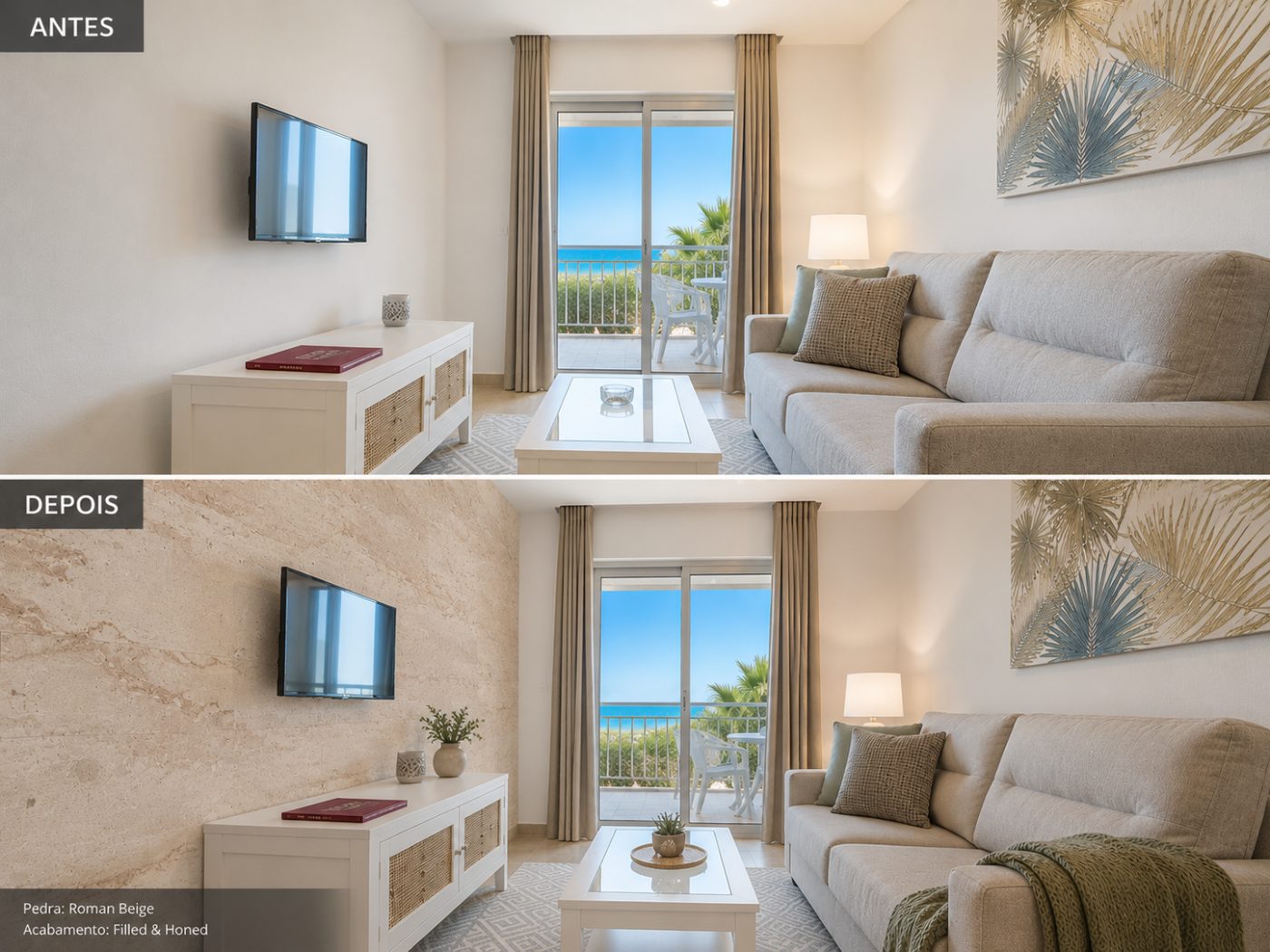
Phase by area and by wing, not room by room
Phasing room by room looks prudent and is almost always the more expensive option: it stretches the works over months, keeps the site compound permanently in place, and spreads the noise across the whole building instead of concentrating it.
The opposite works better — closed, short, sequential blocks:
- Isolate one wing, floor or block at a time and take it out of sale for a short, defined period.
- Concentrate all the material, all the labour and all the noise there.
- Reopen the complete wing before opening the next one.
- Keep bookings away from the block under works — manageable when the block is a single unit, impossible when the rooms under works are scattered.
Treat public areas outside operating hours
You cannot close a reception or a breakfast room for three weeks. But an intervention with no strip-out, with material that cuts dry and comes up in the service lift, is frequently compatible with working between the end of service and the next opening, in defined phases.
It is a conversation to have with the applicator before signing: what can genuinely be done out of hours, and what really does require closing the space.
Use the calendar and the low season
- Public areas and F&B — the tighter window, because they are in use even when the hotel is running at half capacity. Usually the first phase, still in November.
- Bedrooms — the long phase, between January and Easter, in blocks.
- Exteriors, balconies and terraces — the last, and the most weather-dependent. Needs dry weather and an adequate temperature for adhesive and sealant. Plan it for the end of winter, with slack.
Buy the time, not just the material
Lead times and stock availability are part of the construction programme. On a hotel programme, ordering in two or three tranches over several months adds tone risk, supply risk and calendar risk. Securing the full quantity up front, with a phased delivery agreed, is almost always the cheaper decision — even when it looks like the more expensive one on the day you sign.
One local point worth knowing: Korevo dispatches from Loulé, in the Algarve, to mainland Portugal and Spain. For a property here that means a domestic delivery rather than an import — no customs, no shipping lead time from outside the EU, and samples that can be with you in days rather than weeks.
A real project in the Algarve
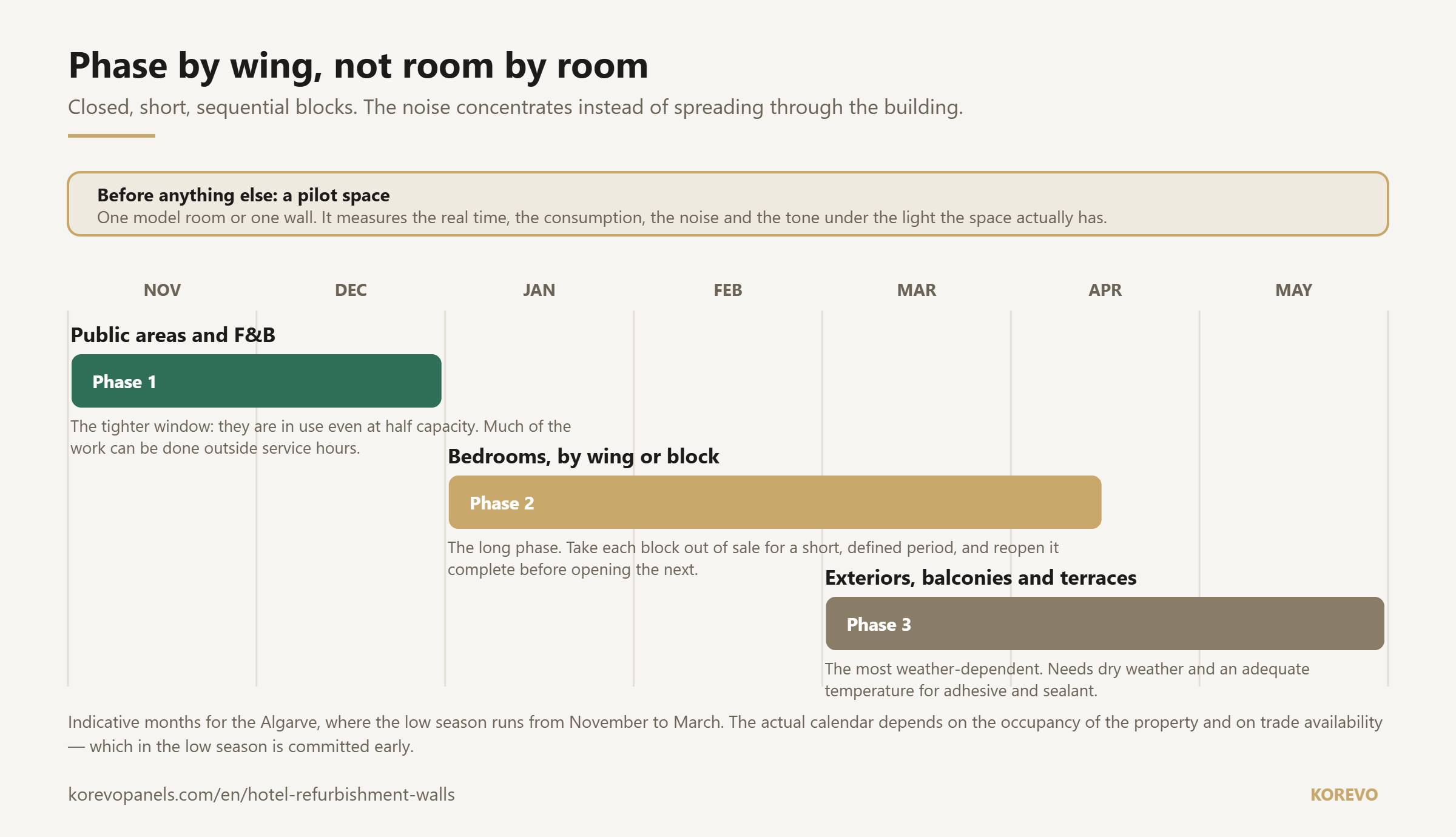
We are currently involved in a refurbishment at a four-star property in the Algarve, a few hundred metres from the sea. It is exactly the scenario described in this article: a hotel in operation, with some room types already refurbished and others not, needing to extend the aesthetic language it has already chosen to the surfaces that have not yet been touched — without losing the season.
We would rather publish this case when it is finished and photographed than publish it now with renders and promises. This section is reserved. When the final photographs are available, this is where they go — before, during and after, untouched.
Photograph of the original condition of the surfaces, before any work.
Photograph of the application process, with the space under works.
Photograph of the completed space, from the same viewpoint as the first image.
If you run a property and would like to see this case when it is published, tell us — we will let you know.
Frequently asked questions
Can flexible stone be used in hotels?
Yes, and it is one of the applications where it makes most sense, precisely because in hospitality the cost of an intervention is not only the cost of the material. Suitability depends on three things: the specific area (there are areas where we do not recommend it, such as kitchens and floors), the condition of the existing substrate, and the reaction-to-fire requirements of the property’s fire safety design. None of these is settled from a catalogue — they are settled with the drawings on the table.
What are the advantages of flexible stone in a refurbishment?
The main ones are operational rather than aesthetic. It is a thin covering, in the order of 3 mm, and light, in the order of 3 kg/m², which in many cases can be applied over the existing finish without strip-out. It cuts dry, follows curved surfaces, and arrives in kits that fit in a service lift. In practice that can reduce the complexity of the intervention, simplify site logistics and allow a less disruptive refurbishment in certain situations — which in a working building is worth more than the difference in price per square metre.
Which areas of a hotel can it be used in?
With good results: reception, corridors and circulation, headboard and TV walls in bedrooms, breakfast rooms and restaurants (outside cooking areas), bar counter fronts, public areas, bathrooms in the dry zone, and sheltered exteriors with the appropriate line. With specific design input: inside showers and spa or indoor pool areas. We do not recommend it in kitchens and grease areas, on floors, or on shower trays and worktops.
Can flexible stone be applied over existing walls?
In many cases, yes — and that is what makes it interesting in refurbishment. But it depends on the substrate and its condition, and the adhesive changes with the case: flexible C2 cement-based adhesive on sound render, plaster or concrete; abrading plus a bonding primer, or a polymer adhesive, over tile and glazed surfaces; contact adhesive on timber. Surfaces with paint or plaster that is lifting, significant deviation or active damp have to be dealt with first. Flexible stone follows the substrate; it does not correct it.
How long does installation take?
We do not give a number, because anyone who does is guessing. The time depends on the condition and preparation required of the surface, the area, the complexity of the trims, the number of openings and corners, and the size and experience of the team. The correct way to answer this question in a hotel is to do a pilot space — one room or one wall — and measure. What you measure in that pilot can then be multiplied across the rest of the programme with confidence.
Does flexible stone meet the fire safety requirements for a hotel in Portugal?
No supplier can answer that with a yes, because the requirement is not a property of the material: it belongs to the location. In Portugal hotels are occupancy type VII under the SCIE regime, and the technical regulation sets different minimum reaction-to-fire classes depending on whether the surface is on an escape route, in a public area or in a bedroom, and on the building’s risk category. What we provide is the test report — the exterior line is classified Euroclass A2-s1,d0 in independent laboratory testing — so that the property’s SCIE designer can check it against the specific requirement for each space.
Does Korevo carry out the installation?
No. Korevo supplies the material and technical support for the project: quantity take-offs, finish selection, samples, technical documentation and application recommendations by substrate type. We have no in-house fitting team. We work with refurbishment companies and applicators and can look for references in the area of the project — without ever promising up front that there is an available partner in your municipality.
Are there commercial terms for hotel-scale projects?
Yes. For companies with a construction, refurbishment or design activity there are trade terms that depend on the volume of each order, handled by named quotation rather than a published price list. Note that trade terms require a Portuguese company tax number (NIF) with a relevant activity code. If you are an architect or designer who specifies without buying, we support the specification — samples, technical documentation and quantity take-offs — and the purchase is made by whoever carries out the work, on those same terms. See the trade and partner terms, or get in touch with the project details.
In short
In a hotel refurbishment, the material is the most visible variable and almost never the most expensive. What decides the outcome is the calendar: how many spaces come out of service, for how long, in which season, and with what effect on the experience of the people who are in the hotel while the work is going on.
A wall covering should therefore be judged on two criteria in parallel — what it does to the wall, and what it does to the operation. Flexible stone is not the answer to every wall in a hotel; there are areas where we do not recommend it and projects where natural stone is clearly the right choice. But on internal vertical surfaces and sheltered exteriors, over sound substrates, in a building that has to keep working, it is a solution that can reduce the complexity of the intervention and shorten the time the space is out of service.
The right way to confirm that is not to believe an article. It is to order samples, see the tones in the light of the actual space, and run a pilot before committing the whole programme.
Talk to Korevo about your refurbishment project.
If you are a hotel owner, general manager, architect, interior designer or contractor with a refurbishment in hand, tell us what you have: the areas, the approximate square metres, the substrate type and the calendar window. We will come back with an honest technical recommendation — including when the answer is that we are not the right solution for that wall.
See Korevo flexible stone · Order samples · Work out quantities in the Planner · Trade terms
Read next
- Inspiration & Guides — all Korevo guides in English.
- Flexible stone in Portugal — what it is, how it compares with natural stone, and where it is used.
- How to install · Videos · FAQ